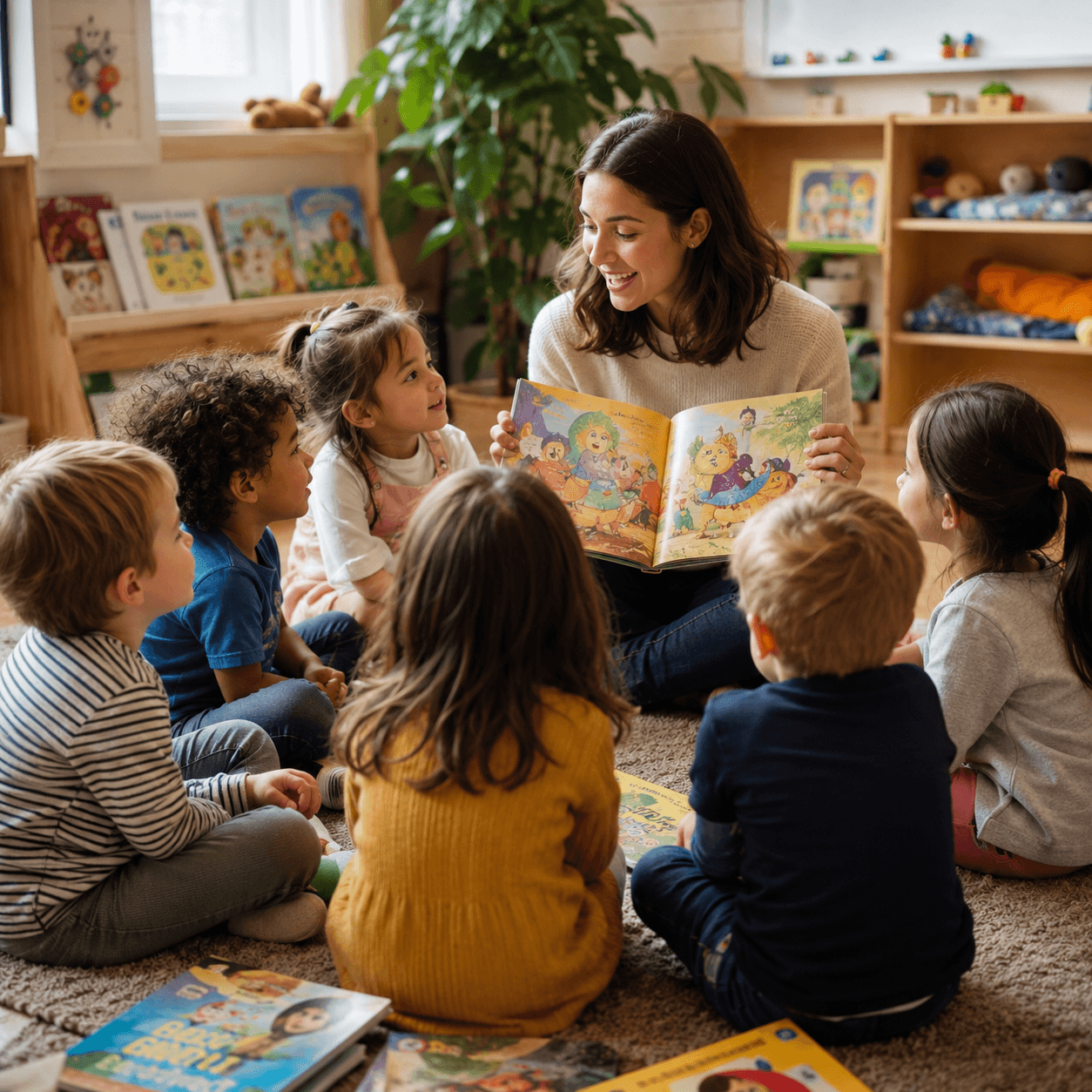
In the current 2026 preschool English approach, English education for ages 3-6 should be planned so that children not only hear the language but also use it meaningfully in class. In this age range, children learn the language not through rules but through experience. For this reason the program needs to take the age differences into account.
Age 3: short, visual and active
In the 3 age group, the attention span is short. English should be presented with basic words such as colors, numbers, animals and emotions, with short instructions and plenty of movement. Instead of expecting long answers from the child, their giving the right response is supported.
Age 4: matching and active participation
At age 4 the child can choose a card, follow simple instructions and do short repetitions. In this period games and songs should still be at the center; but the child begins to show more conscious participation.
Age 5: short patterns and story flow
At age 5 the child does not just say a word but begins to express what they see. Short patterns like I see, I like, It is can be used naturally within a story and a game.
Age 6: school readiness and communication
In the 6 age group, question-and-answer, listening comprehension and simple communication skills grow stronger. Preparation for the Cambridge English foundation can become more noticeable at this age; however, the preschool spirit of play should be preserved.
Why is a graded program important?
Giving the same content to every age both strains younger children and leaves older children unchallenged. A graded program lets each age move forward ready for the next level.
How Woody and Friends works in practice
The Woody and Friends system brings together the book, the teacher plan, the game materials, character support, StoryLand stories and MusicLand songs around the same learning goal. This way the child first recognizes a concept visually, then responds to it in a game, repeats it through a song and notices its context within a story. For the teacher, this structure makes it clearer which learning objective is supported by which material each week.
An example classroom flow
English education for ages 3-6 produces stronger results when it is applied in short, repeatable steps in the classroom. The teacher first introduces the target word or pattern with a visual, then waits for small responses from the children, such as choosing a card, moving, matching or answering the character. At this stage the aim is not to push the child, but to turn English into a safe classroom experience.
In the second step, the same objective is repeated within a game or a song. When the child hears the word again in a different context, learning becomes more lasting. In the third step, the topic is carried into a calm reinforcement area through a story, a worksheet or a craft activity. This cycle keeps attention alive, especially in preschool classrooms, and makes it easier for the teacher to manage the lesson.
Implementation notes for the teacher
The teacher should set a single main goal for each activity. Using too many words, instructions that are too long or overly complex games in the same lesson can distract the children. For better results, short instructions, clear visuals, plenty of repetition and positive feedback should be preferred. Even if the child does not answer, behaviors such as listening, looking, pointing to a card and responding to an instruction should be accepted as part of learning.
This approach allows the teacher to stay flexible in the classroom. If the group is restless, the game can be shortened; if the group is ready, a question-and-answer step can be added. What matters is that the material guides the teacher and that every activity serves a specific learning objective.
Benefits for the school and parents
When English education for ages 3-6 is presented with a model that can be explained on the school's side, it increases parents' trust. Parents should be able to see not only which page the child completed in the book, but also which word was repeated through a game, through which song and within which story. This transparency makes the school's English education look more professional.
A standard flow also matters for the school management. Even if different teachers work in different classes, the same objective logic, the same repetition cycle and the same quality language are preserved. For this reason Woody and Friends does not leave the material on its own; it makes the process more trackable with a teacher plan, digital repetition and character-supported activities.
Checklist
When a school evaluates this topic, it should look not only at the number of materials, but also at whether the application is genuinely sustainable in the classroom.
- Are there short instructions for age 3?
- Is there a matching and choosing activity for age 4?
- Are there short sentence patterns for age 5?
- Is there a question-answer and listening flow for age 6?
- Are the levels connected to each other?
To plan this topic at the school level you can review the Woody School Series page, and for out-of-class repetition and digital support you can review the Woody Digital content.
Frequently Asked Questions
Is age 3 too early for English?
With the right method it is not too early. At this age the goal is play, sound, rhythm and familiarity with basic words.
Should grammar be taught at age 6?
Instead of explicit grammar instruction, short patterns, question-and-answer and meaningful use should be preferred.
Can the age groups use the same book?
They can progress within the same system, but the content density and activity types should be separated by age.
How does Woody handle the age levels?
Woody and Friends arranges the age levels gradually with the teacher plan, materials and digital repetition flows.