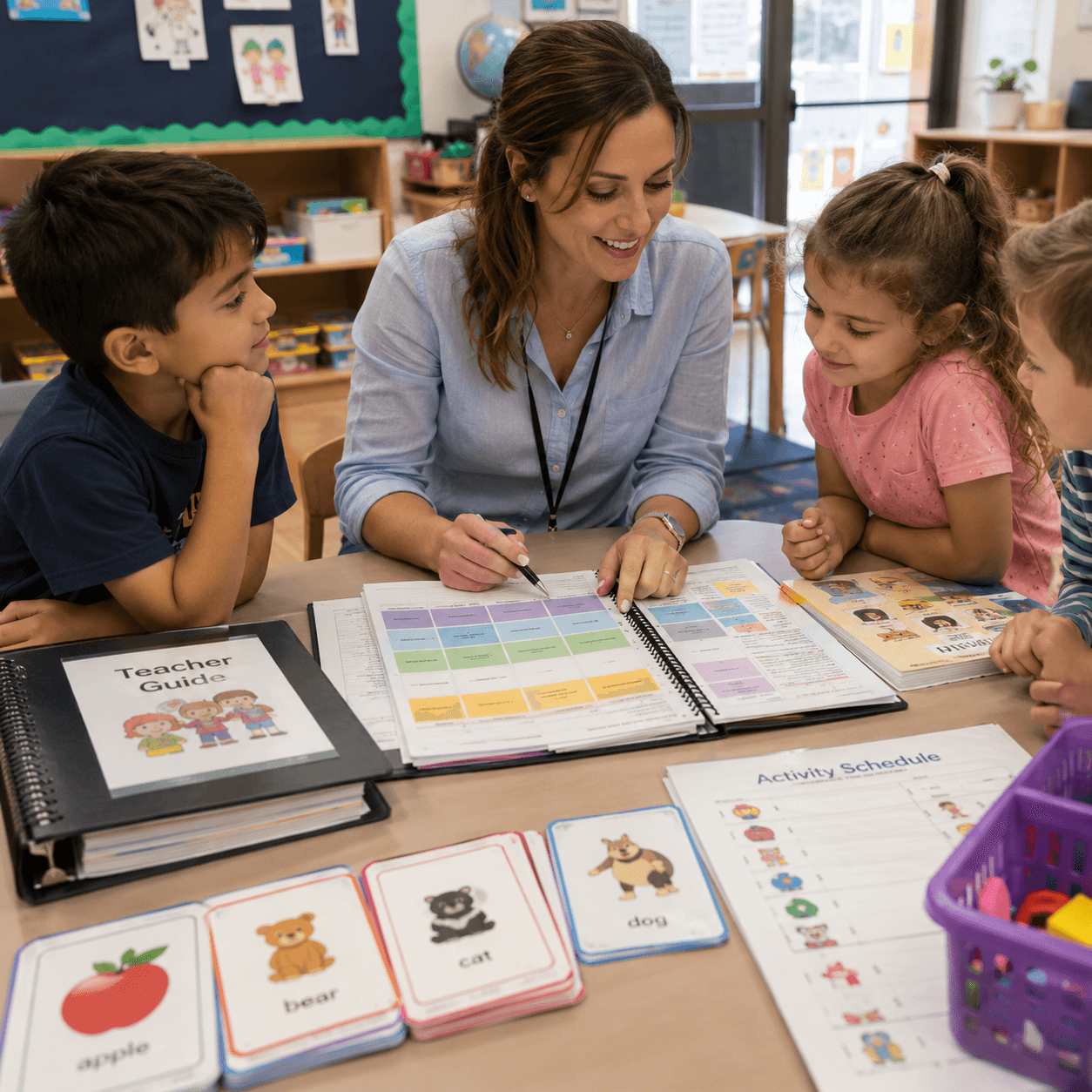
In the current 2026 preschool English approach, a preschool English lesson plan should be planned so that children not only hear the language but also use it meaningfully in class. The lesson plan is the main road map that determines in what order the teacher will enter the class, which word they will cover with which activity, and how the child will take part in the lesson.
Why is a lesson plan not just a list of topics?
In preschool, a lesson plan is not simply writing down the week's words and leaving it at that. The children's attention span, need for movement, need for repetition and way of forming an emotional bond should all be taken into account. While the 3 age group needs shorter and more active flows, simple question-and-answer, matching and story following can take up more space at ages 5-6. The plan makes these differences visible.
How should the weekly flow be set up?
A good weekly flow consists of introduction, repetition, game, story, song and reinforcement sections. In the first lesson the word is introduced with visual support, in the second lesson it is energized with a game, and in the third lesson it gains context with a song or story. At the end of the week, learning is made visible with a worksheet, craft or short assessment activity.
Matching objectives and materials
Every activity should be tied to an objective. If colors are being covered, the flashcard, color hunt, song and story should support the same word group. If animals are being covered, the child should not just repeat the animal's name; they should imitate the sound, choose the right card, answer the character's question and follow a short instruction.
Applicability for the teacher
The plan should not be so dense that it cannot be applied in class. When the preschool teacher opens the material, they should be able to see which activity to do for how many minutes. Short instructions, alternative games and notes on simplifying by age reduce the teacher's load. This structure creates standard quality within the school.
How should assessment be done?
In preschool, assessment should not be thought of like an exam. The child choosing the card, responding to an instruction, catching the word in a song or pointing to the visual in the story provides enough data. The teacher can follow these observations with short notes.
How Woody and Friends works in practice
The Woody and Friends system brings together the book, the teacher plan, the game materials, character support, StoryLand stories and MusicLand songs around the same learning goal. This way the child first recognizes a concept visually, then responds to it in a game, repeats it through a song and notices its context within a story. For the teacher, this structure makes it clearer which learning objective is supported by which material each week.
An example classroom flow
A preschool English lesson plan produces stronger results when it is applied in short, repeatable steps in the classroom. The teacher first introduces the target word or pattern with a visual, then waits for small responses from the children, such as choosing a card, moving, matching or answering the character. At this stage the aim is not to push the child, but to turn English into a safe classroom experience.
In the second step, the same objective is repeated within a game or a song. When the child hears the word again in a different context, learning becomes more lasting. In the third step, the topic is carried into a calm reinforcement area through a story, a worksheet or a craft activity. This cycle keeps attention alive, especially in preschool classrooms, and makes it easier for the teacher to manage the lesson.
Implementation notes for the teacher
The teacher should set a single main goal for each activity. Using too many words, instructions that are too long or overly complex games in the same lesson can distract the children. For better results, short instructions, clear visuals, plenty of repetition and positive feedback should be preferred. Even if the child does not answer, behaviors such as listening, looking, pointing to a card and responding to an instruction should be accepted as part of learning.
This approach allows the teacher to stay flexible in the classroom. If the group is restless, the game can be shortened; if the group is ready, a question-and-answer step can be added. What matters is that the material guides the teacher and that every activity serves a specific learning objective.
Benefits for the school and parents
When A preschool English lesson plan is presented with a model that can be explained on the school's side, it increases parents' trust. Parents should be able to see not only which page the child completed in the book, but also which word was repeated through a game, through which song and within which story. This transparency makes the school's English education look more professional.
A standard flow also matters for the school management. Even if different teachers work in different classes, the same objective logic, the same repetition cycle and the same quality language are preserved. For this reason Woody and Friends does not leave the material on its own; it makes the process more trackable with a teacher plan, digital repetition and character-supported activities.
Checklist
When a school evaluates this topic, it should look not only at the number of materials, but also at whether the application is genuinely sustainable in the classroom.
- Is the weekly objective clear?
- Is the activity order suited to the children's attention span?
- Do the song and story support the same word group?
- Is there an alternative game suggestion for the teacher?
- Is there an observable reinforcement activity at the end of the week?
To plan this topic at the school level you can review the Woody School Series page, and for out-of-class repetition and digital support you can review the Woody Digital content.
Frequently Asked Questions
How long should a preschool English lesson plan be?
It varies by age group. Shorter blocks should be used at age 3, and longer but more active flows at ages 5-6.
Should a song be used in every lesson?
A song is a strong repetition tool; it is not mandatory in every lesson, but having it regularly in the weekly flow strengthens learning.
Why is a game important in a lesson plan?
A game takes the child out of being a passive listener. The child listens, chooses, moves and responds to English.
Does a plan restrict the teacher?
A good plan does not restrict the teacher; on the contrary, it gives them a clear backbone and makes it easier to make small adaptations according to the class.